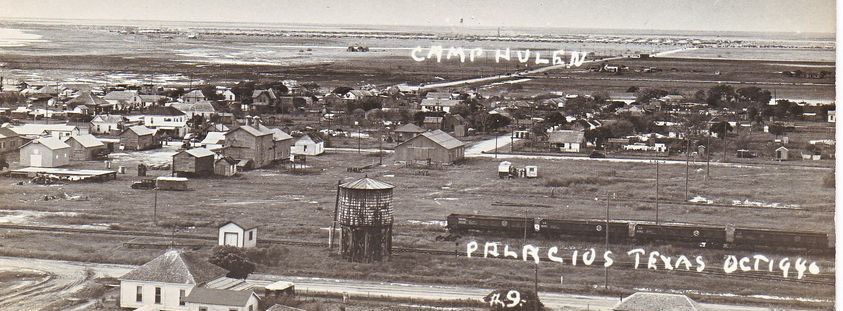
EDITOR’S NOTE: A Bay City newspaper editor’s visit to Palacios in 1903 found the train made a significant impact on the new city. Also on this page are photos that show the train and depot. The first train arrived in June 1903.
The editor went to Palacios Monday evening, returning next morning, and by keeping his eyes and ears open, he learned several things that will interest his readers.
On the way over he had as delightful traveling companions as far as Blessing, Jas. H. Logan and A. B. Pierce, two forceful young citizens now and destined still more to be important factors in developing that fine section of our county.
Mr. Logan has gotten well started with his new store and is station agent and postmaster as well as merchant.
Mr. Pierce is one of the chief land proprietors of the west side and one of the most progressive and intelligent developers.
He called our attention to a new artesian well on the Pierce lands, about 75 feet from the railroad track.
It is 336 feet deep, has 19 feet of very coarse water-bearing sand, and sends forth a constant stream of pure, soft, sparking water at the rate of forty gallons a minute from a three inch pipe.
It cost about $400.
He estimates that a twelve-inch well of same depth, costing six or seven hundred dollars, would water 100 acres of rice.
C. W. Eubanks, road-master of the Caney Valley branch, was also a most agreeable companion both going and coming.
He has a large force of hands surfacing up the track, and another force fencing the right-of-way, putting in crossings, constructing cattle-guards, etc.
At Palacios he called our attention to an artesian well just receiving finishing touches, bored for his company by Mr. Young.
The water of this well is also pure, clear and soft, and comes up from a depth of 320 feet and is found in a stratum of good sand 19 1-2 feet thick.
It is expected to flow 50 or 60 gallons a minute from a four inch pipe.
At Blessing, Mrs. A. A. Duffy of Matagorda and her two children boarded the train and went to Palacios to visit her sister, Mrs. David Baxter. She had been visiting her brothers, W. H. and John P. Spoon [Spoor?].
Palacios seemed to be flourishing.
The townsite company’s new hotel building is nearing completion.
Station Agent A. R. Hillyer has just erected a large two-story residence on the south bluff.
David Baxter has built another on the east bluff, and Ruthven & Hillyer have built a wharf and oyster house on the bay and a large warehouse opposite the depot.
The new depot is a modern structure, complete in all of its appointments, and neither the railroad company nor the townsite company seems to be neglecting anything that will further the interests of the beautiful little city.
The townsite company has a force of men and teams still at work grading the streets and ditching the land where necessary.
Bathing is still fine, the hotel accommodations all that could be desired and here the tired man or fagged out woman may still find an ideal place for rest and recuperation.
In a business way, everybody seemed to be doing well.
Carpenters were all busy.
Blacksmith Powell had just received a new well rig and was boring a well.
Pybus Bros. and David Baxter both reported their stores reasonable well patronized and Ruthven & Hillyer expect to be ready to start their oyster business about the 15th instant.
Socially, everybody seemed to be contented.
We visited the families of J. L. Pybus and David Baxter, and the ladies at both places said they were delighted with Palacios, while at the hotel Mine Hosts A. B. Welch and E. H. Reese were cheery and as happy as clams in high tide.
In the hotel office we saw some splendid specimens of Japan rice from a 20-acre patch grown by the company some miles north of town and watered by a windmill.
It made a fine crop and was being harvested.
At Palacios, Blessing and Midfields the editor satisfactorily arranged several business matters and by 8:30 next morning he was back at his desk hard at work at the daily routine, for which his outing had given him a keener relish.
Matagorda County Tribune Supplement,
October 9, 1903