
From Matagorda County History & Genealogy page
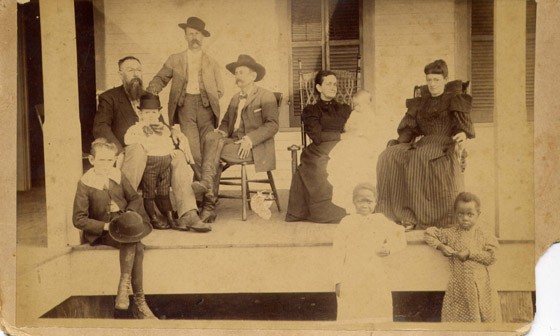
Rotherwood
Mary L. White was born in 1815 in Knoxville, Tenn., whence she came with her father, the late B.J. White, to Texana, Jackson County, Texas in 1830.
Mr. White settled first with his family on the Navidad.
In 1833 she was married to Colonel Robert H. Williams of Caney, Matagorda County, Texas.
In 1859 she was confirmed by Bishop Gregg in Christ Church, Matagorda, and thus became a member of the Episcopal Church, of which she continued to be a firm, consistent and devout member to the day of her death on January 2, 1888.
Polly Rugeley Fitz-Gerald in recounting early recollections of her childhood in Matagorda County had this to say:
San Antonio has been my home for fifty years, but my fondest memories are those of Old Caney in Matagorda County.
My grandfather was the well known and beloved [Christopher Harris] “Kit” Williams of that County.
His father, Robert H.
Williams, was on of “The Old Three Hundred,” who settled Texas in 1823 and was given a land grant of 4,428 acres.
The grant is listed as the R.H. Williams Survey No. 44 and was signed by Stephen F. Austin.
My father was John Lamar Rugeley and my mother was Laura Roberta Williams who were both born in the “Deep South of Texas” between the Brazos and the Colorado rivers.
I was born and spent my very early childhood on my grandfather Williams’ plantation, “Rotherwood,” situated below Bay City about eighteen miles from the Gulf and right on Caney Creek.
During my life on the plantation I had no playmates except a young black girl whose duty was to safeguard and amuse me.
She taught me much about the life there, but my greatest teacher and confidant was my grandfather.
He was a lover of nature and he had no difficulty in imparting that love to me.
He taught me the habits and haunts of the birds - their calls and colors—their migrations -their coming in the Spring and their departure in the Winter.
The woods around here were filled with animals of all kinds and I knew them well.
I learned, too, of plantation life in general—the beauty of a cotton field in bloom stretching as far as the eye could see - the smokehouse with hams, sausages and bacon hanging from the rafters, the dirt floor, the thin spirals of smock ascending to complete the curing process; the tall corn and the sugarcane growing, and the small tobacco patches from which the servants cured and manufactured their own tobacco.
On Sunday morning we had religious services which consisted of reading a chapter from the Bible or Prayer Book as there were no nearby churches.
We were all Episcopalians.
After the little service at home we spent the day, if we had no callers, visiting nearby plantations.
We, of course, went by horse and buggy.
Among those I recall are the Bowie, Le Tulle, Thompson and Box plantations also jaunts to Wharton, Bay City and Matagorda.
These were great events in my young life, first of all because I was related to everyone in the County having the distinction of having been born a Rugeley, and secondly these visits away from “Rotherwood” gave me the opportunity to play with other children.
Another thrill was going to the general store at Hawkinsville and also visiting the beautiful old plantation home.
Oak trees with hanging moss covered many of the roads through the woods on these trips and now and then we would come to a wide open prairie where yellow, pink and white buttercups grew along with Indian paint brush, and I had to be restrained because I wanted to stop and pick them.
If they didn’t stop I would resort to tears which halted the buggy immediately for I can never remember my grandfather denying me anything; so I was allowed to pick flowers to my heart’s content.
I well remember the first automobile I ever saw, Rowland Rugeley and the Hawkins girls (Meta, Janie, Lizzie and Elmore) all cousins, came down to visit us for the day.
They honked the horn with great gusto to show off the car, and the horses and mules were scared to death, running wildly around their pastures and attempting to jump the high barbed wire fence which enclosed them.
Many of them were severely cut and after the departure of the visitors, my grandfather with several of the blacks spent hours treating and sewing up the wounds.
It must have been around 1906 or 1907.
There were few automobiles then, and none to my knowledge had ever been down to Caney before.
No wonder the poor animals were frightened.
At the entrance to lovely old “Rotherwood” there were two cannon balls adorning the front gate, one on either side.
My grandfather picked them up on the beach after the Civil War.
I remember, too, the blue lightening rods on top of the house.
The entrance hall was covered with deer skins and there were antlers all around the wall.
They were trophies of my grandfather.
It also contained his desk which had been in the family for generations.
Above the desk hung a saber taken from a dead “Yankee” which he had sought to return after the Civil War.
However, he was unable to locate the heirs.
Three or four double barreled shot guns were always behind the front door (a holdover possibly from the Indian days).
There was also a huge medicine chest from which all medicines were dispensed to anyone ill.
I can see the parlor now; Pampas grass - jardinieres on the mantle; family portraits all around the room on easels; an enormous bookcase with glass doors containing the classics and a stereoscope with selected views which I was allowed to look through on special occasions.
These were the days of kerosene lamps, cistern water purified by charcoal, the only drinking water available.
Back of the house was a lovely orchard of pear, peach and plum trees, a glorious sight when in bloom, watermelon and cantaloupe patches.
Near the kitchen was a tiny garden of tomatoes, onions and herbs.
I love to watch the rabbits nibble on the lettuce and would never tell grandfather that they were there, as he would chase them away.
Between the house and the lake was a family cemetery with an iron fence surrounding it.
Two miles from the house was a large lake stocked with all kinds of fish and no one could fish there without my grandfather’s permission.
It contained a small island covered with maiden hair fern and wild violets, and sometimes he would take me over there in a small row boat.
He always took a gun along, for the lake was full of alligators and he would fire to scare them away if they came too close.
The delight of my life was the dear season and hog killing time, crackling, corn bread, hot biscuits, and peach preserves.
My grandfather had spent a lot of his boyhood in New Orleans and was a superb cook.
When he went into the kitchen to prepare some of his famous dishes, the servants cleared out.
Of all the dishes I remember best his crab gumbo, his squirrel stew and the oysters which the blacks brought up from the Gulf were my favorites.
These he prepared in a half dozen ways.
The shells were used to make walks.
He taught me how to open oysters and how to clean a crab, to fish for perch, cut a branch from a willow tree, put a fish on it and hang it half way in the water to keep fresh until you were ready to go home, but sometimes water moccasins would swim along and carry the fish away.
He taught me how to troll for trout, how to crab, how to keep the crabs in a wet gunny sack until time to cook them, and how to pick them up so they wouldn’t hurt me.
These are some of my childhood memories of that delightful spot, my heritage and that land I shall always cherish.
When we visited the family cemetery, Rotherwood last summer, the manager of the plantation told us that one night several winters ago someone drove a truck into the cemetery and carried away all of the old tombstones except one large stone that had fallen over during the last storm.
It was almost buried under the trunk of a huge, old tree.
He told us also that stones were frequently stolen from deserted plantation cemeteries, the engravings removed, and used again.
Rotherwood itself met the fate of so many of the plantations on Caney; it was burned so many years ago that only a gnarled old sweet myrtle stands to mark its site.
Thus our only memory of it comes from little Polly’s story.
21 Sons For Texas by Arda Talbot Allen, pp. 39 - 42