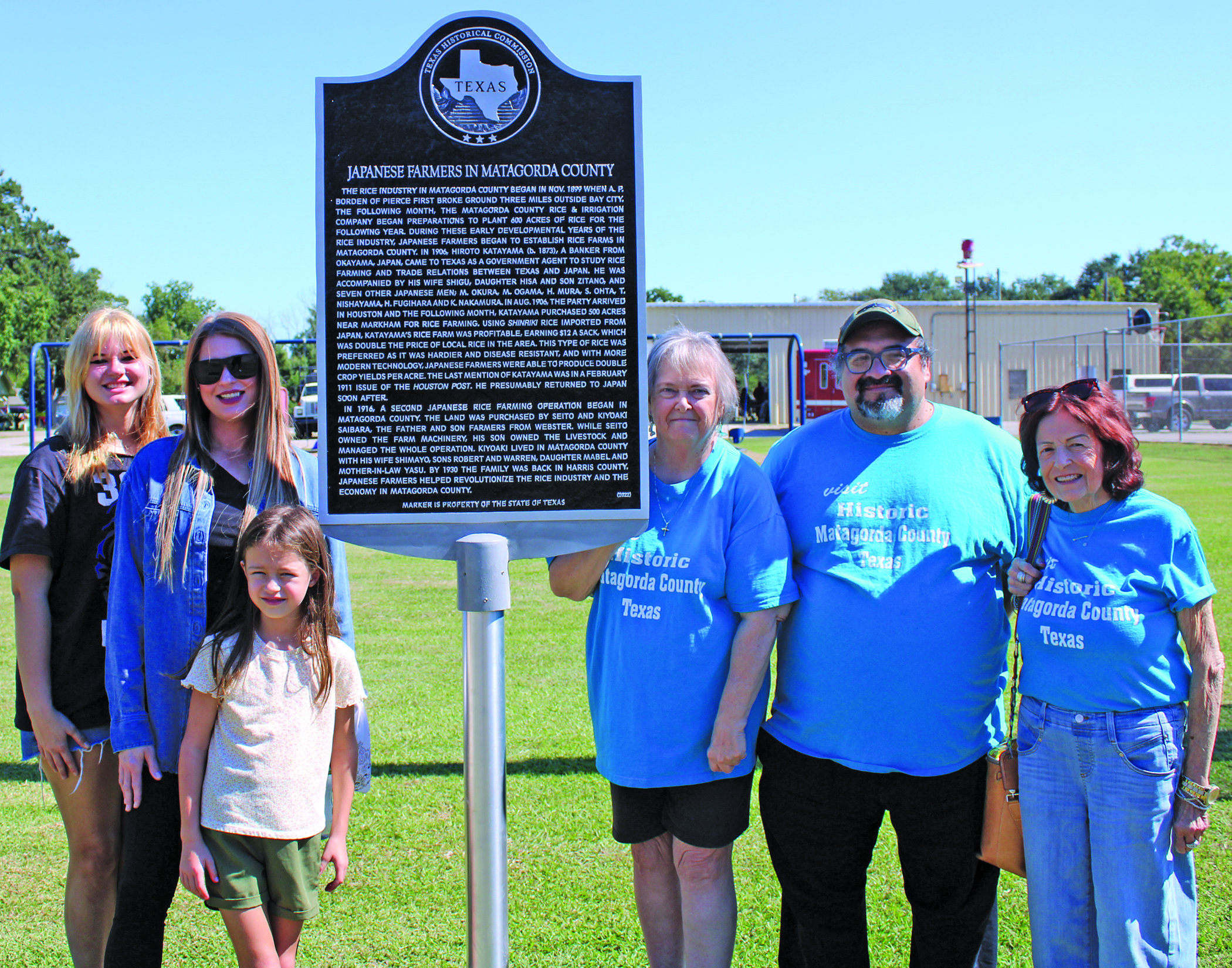
Matagorda County Historical Commission dedicated a Texas Historical Commission historical marker recognizing the “Japanese Farmers in Matagorda County” at the Markham Community Center Saturday, Oct. 11.
The marker explains how the Japanese farmers arrived not long after the rice industry began in Matagorda County in November 1899.
That’s when A.P. Borden of Pierce, in Wharton County, broke ground three miles outside of the Bay City.
The rice industry’s growth in Matagorda County seemed almost nothing less than amazing as the Matagorda County Rice & Irrigation Company began plans to plant 600 acres for the following year.
It was during these early development years that Japanese farmers began establishing rice farms in Matagorda County.
In 1906, Hiroto Katayama, a banker from Okayama, Japan, came to Texas as a government agent to study rice farming and trade relations between Texas and Japan.
With him were his wife Shigu, daughter Hisa, and son Zitano, and seven other Japanese men.
In August 1906 the party arrived in Houston and Katayama bought 500 acres near Markham for rice farming.
Using Shinariki rice imported from
See Farmers, Page 2
Japan, Katayama rice farm was profitable, earning $12 a sack, which was double the price of local rice in the area.
This type of rice was preferred because it was hardier and disease resistant and with more modern technology, Japanese farmers were able to produced double crop yields per acre.
The marker narrative points out that the last mention of Katayama was in a February 1911 issue of the Houston Post.
“He presumably returned to Japan soon after.
In 1916, a second Japanese rice farming operation began in Matagorda County.
The land was purchased by Seito and Kiyoaki Saibara, the father and son farmers from Webster, while Seito owned the farm machinery, his son owned the livestock and managed the whole operation.
Kiyoaki lived in Matagorda County with his wife Shimayo, sons Robert and Warren, daughter Mabel and mother-in-law Yasu.
By 1930, the family was back in Harris County.
Japanese farmers helped revolutionize the rice industry and the economy in Matagorda County.
