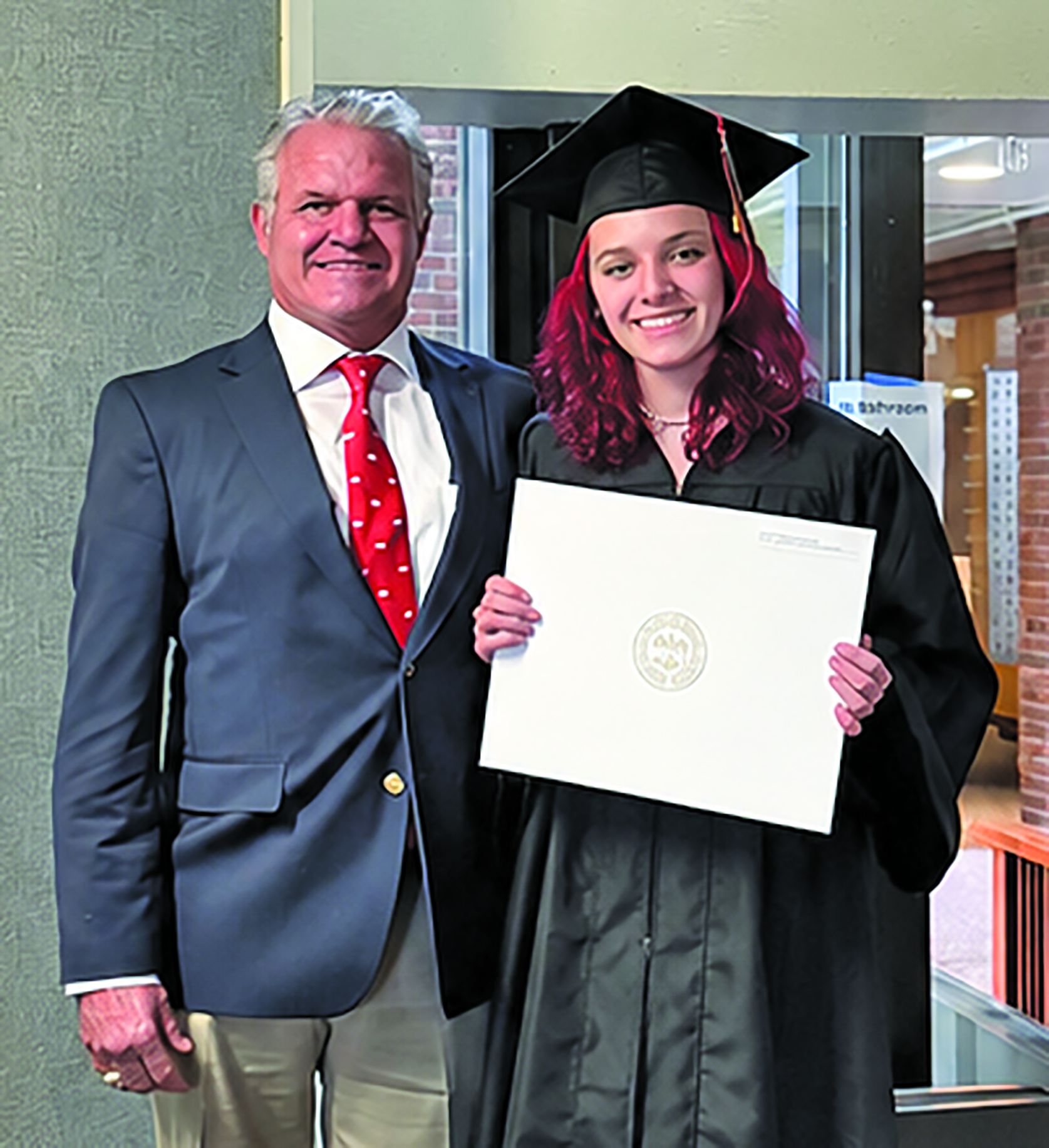
Amber Michelle Simons – the daughter of Bay City Physician Dr. Dane Simons – graduated Magna Cum Laude from Harvard University with a degree in Psychology last week.
She received the highest academic honor an undergraduate at Harvard can receive, being elected into the Phi Beta Kappa Society.
Next month, she has secured a position at Northwestern University where she will be working - doing Psychology research and preparing to pursue her PhD.
Simons is a fifth-generation Bay City resident.
Simons’ great-great-grandfather first came to Bay City to practice medicine in 1893.
Her great-grandfather was a physician in Old Gulf, then in New Gulf, and his brother was a Bay City physician.
Amber Simons’ grandfather was a dentist in Bay City.
She was born Oct. 11, 2003, at Matagorda General Hospital and lived with her father in Bay City and his ranch in Buckeye most of her young life.
She went through CDC then Sunshine and Rainbows and then 1st through 5th grade at Holy Cross Catholic School.
In 6th grade on, she went to Needville public schools, but still spent half of her time in Bay City with her father.
She helped at the ranch, loved her horse and all animals.
Simons was an accomplished barrel racer.
She graduated as Salutatorian from Needville High School and was accepted to Harvard – they had a 3.1% acceptance rate that year.
As she commences her Psychology research and prepares to pursue a doctorate, Simons said her focus on Psychology began her sophomore year at Harvard – the year the university requires students to declare a major.
Now moving to Chicago, where Northwestern is located, Simons explains she chose psychology research to study “how people interact with each other in the context of society.
“I find it interesting.”
Simons said she made many connections at Harvard with professors and friends.
She points out that research takes in many fields.
Her college thesis works on psychology research won honors.
She wrote papers on how people’s perceptions “always differ.
“You use research to inform different theories.
“I’m looking to see research on how different policies influence social intervention,” Simons said.
“It’s the way we talk about things.”
